


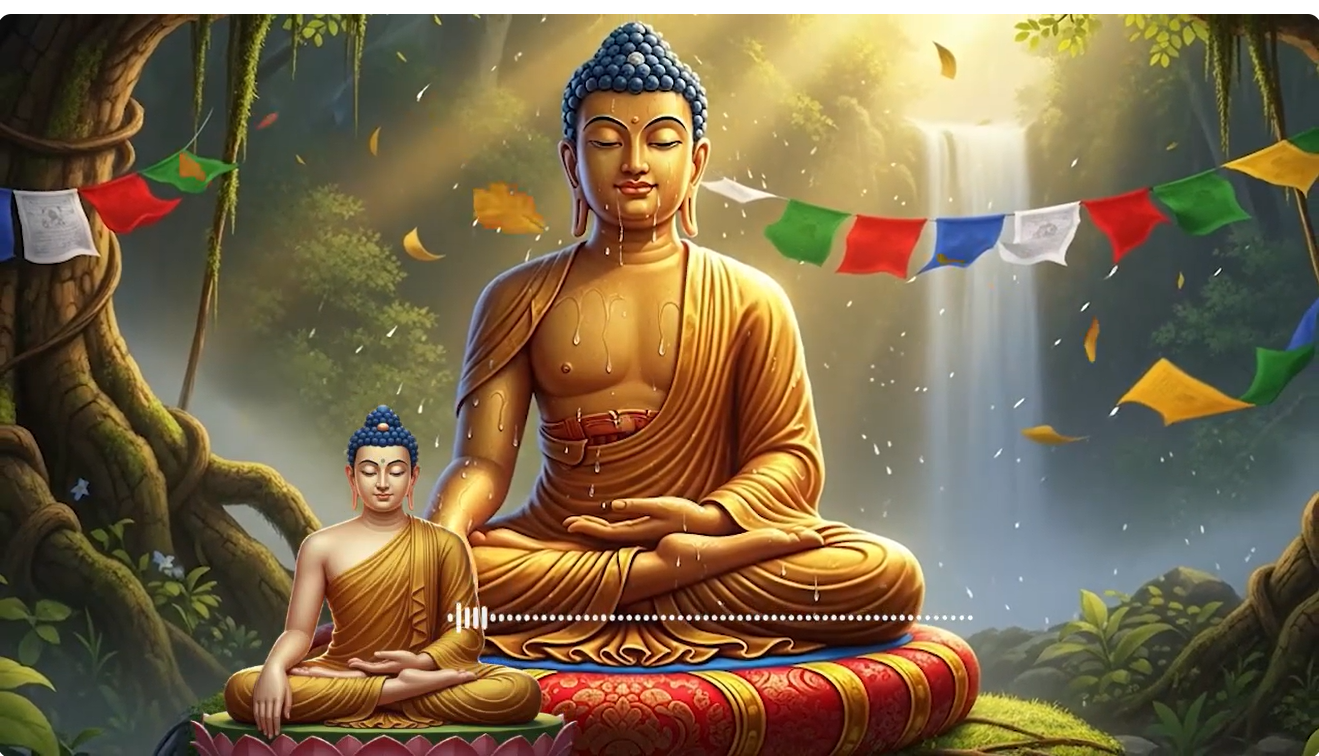
bodhi tree=enlightenment

The Prince Who Had Everything
Long before temples and statues, before monks in saffron robes and quiet meditation halls, there was simply a child — a boy born into luxury. His name was Siddhartha Gautama, and he entered the world around the 5th century BCE in what is now modern-day Nepal. His father was a powerful ruler who loved him deeply and feared one thing above all: a prophecy. Wise men had foretold that the child would grow to become either a mighty king or a great spiritual teacher who would abandon worldly power forever.
Determined to shape his son’s destiny, the king built a perfect life around him. Siddhartha lived inside magnificent palaces filled with music, gardens, dancing, and endless comfort. Servants attended to his needs, and guards ensured he never encountered anything unpleasant. He married, had a child, and experienced every luxury a human life could offer. Yet despite the beauty around him, a quiet question slowly grew inside his mind: Why did happiness feel so fragile?
The Four Sights
One day, curious about the world beyond the palace walls, Siddhartha convinced his attendant to take him into the city. What he saw changed everything. First, he encountered an old man, bent and trembling with age. Next, he saw a person suffering from illness. Then he witnessed a funeral procession — death itself. For the first time, he realized that no wealth, power, or comfort could protect anyone from aging, sickness, and mortality.
Finally, he saw a wandering monk, calm and peaceful despite owning nothing. The man’s face held a kind of stillness Siddhartha had never seen among nobles or kings. In that moment, he understood that people were not suffering because they lacked pleasure — they were suffering because life itself was uncertain and constantly changing.
The Great Departure
At night, he looked at his sleeping wife and infant son. He loved them deeply, but he also knew he could not ignore the question that now consumed him: Is there a way for human beings to live without fear and endless dissatisfaction? Quietly, he left the palace behind, trading silk garments for simple robes and the title of prince for that of a seeker.
For years he studied, fasted, and practiced extreme self-denial, nearly starving himself in his search for truth. Yet he discovered that suffering did not disappear through luxury, nor through harsh punishment of the body. There had to be another way.
The Awakening
Finally, he sat beneath a tree and made a decision. He would not rise until he understood the nature of the human mind and suffering. Through deep meditation he observed thoughts, desires, fears, and attachments, watching how they appeared and vanished like clouds passing through the sky.
By morning, something had changed. He no longer saw himself as separate from life. He understood that suffering came from clinging — from our constant attempt to hold onto what must naturally change. Peace, he realized, did not come from controlling the world, but from understanding it.
From that day forward, Siddhartha Gautama became known as Buddha, meaning “the awakened one.” Rather than founding a religion, he simply began walking from village to village, teaching ordinary people a practical path: awareness, compassion, and freedom from fear. His message was gentle but powerful — that peace was not something granted by a ruler or a priest, but something discoverable within the human heart.
life lessons for us
On a gray Tuesday morning, Daniel woke to the sound of three alarms, a vibrating phone, and a mind already racing. Emails were waiting, bills were due, traffic would be heavy, and the news on his screen made the world feel louder before his feet even touched the floor. He rushed through coffee, barely tasted breakfast, and snapped at his wife without meaning to. By the time he reached work, his day had not really begun — yet he already felt exhausted.
That afternoon, during a short break, he sat in his car instead of scrolling his phone. For the first time in a long while, he noticed his breathing. It was fast, tight, almost panicked. He remembered reading about Siddhartha Gautama, who taught that much of our suffering comes not from life itself, but from how tightly we grip every thought, worry, and expectation. So Daniel tried something simple. He closed his eyes and took ten slow breaths.
Nothing magical happened. His problems were still there. But something subtle changed. The noise in his head softened. The meeting he feared became just a conversation. The traffic jam became a moment to listen to music instead of a battle to win. That evening he spoke gently at home, and for the first time in months dinner felt peaceful.
Daniel realized he could not control deadlines, money, or the behavior of others. Yet he could change how he met them. Like the one later called the Buddha, he began practicing small pauses — a breath before replying, a moment before anger, attention instead of reaction. Gradually his world did not become quieter; he became calmer within it.
And that was the beginning of a better life, not by escaping the modern world, but by living inside it with awareness instead of constant struggle.
The Real Purpose of Life (Not What 99% Think) & The Buddha’s Answer
The Question Everyone Eventually Asks
At some point in life, almost everyone quietly asks: Why am I really here?
We chase success, money, relationships, and experiences believing they will finally make us feel complete. Yet even after reaching something we wanted for years, a strange feeling returns — a subtle emptiness. The promotion comes, the vacation ends, the excitement fades, and life feels the same again.
It leaves us wondering… Is this really all life is?
Why Achievement Doesn’t Satisfy
Our culture teaches that happiness is the purpose of life. From childhood we’re told to get good grades, build a career, buy a home, and accumulate experiences. We assume satisfaction will appear once everything is in place.
But it never quite does.
Even people who reach the top — celebrities, millionaires, geniuses — often admit they still feel restless inside. The reason is simple: achievement changes circumstances, but it does not quiet the mind. The mind immediately creates a new desire, a new worry, or a new fear. What once felt important becomes normal, and the search starts again.
The problem is not that we haven’t achieved enough.
The problem is that we misunderstand what we are actually looking for.
The Endless Loop of Wanting
Human life runs on a pattern: wanting, getting, and then wanting again.
We think we are chasing happiness, but in truth we are usually trying to escape discomfort. Boredom, anxiety, loneliness, or insecurity push us toward distraction — food, entertainment, social media, work, or achievement. The pleasure we feel afterward is mostly relief from tension, not lasting peace.
It works briefly. Then the mind becomes restless again.
Like scratching an itch, the relief feels good for a moment — but the itch returns. So we keep scratching our entire lives, calling it happiness.
What the Buddha Discovered
Over 2,500 years ago, a prince named Siddhartha lived in complete comfort and luxury. He had everything people dream about — wealth, pleasure, and security. Yet he noticed something disturbing: even the happiest life could not escape aging, sickness, loss, and death.
He realized suffering was not an accident in life.
It was built into how the human mind works.
So he left his palace, not to start a religion, but to answer one question:
Why do human beings suffer even when life goes well?
After years of deep reflection, he awakened to a simple insight:
Suffering is not caused by life itself.
It is caused by attachment and craving.
We suffer because we constantly demand that life match our expectations — that things stay the same, that people never leave, that success never fades, and that we always feel good. But life is always changing. The mind fights this change, and that struggle becomes suffering.
The Four Realizations
The Buddha summarized his discovery into four clear truths:
Life always contains dissatisfaction.
The cause is craving — the constant mental “I need more” or “this must not happen.”
If craving ends, suffering ends.
There is a practical way to live that gradually frees the mind.
He wasn’t saying life is miserable.
He was saying we create extra pain by resisting reality.
Why Happiness Cannot Be the Goal
Modern psychology now confirms something similar: people who obsess over being happy often become more anxious and dissatisfied. Happiness as a goal becomes pressure.
The more we chase it, the more we notice its absence.
But when people focus on understanding life, helping others, and living with awareness, happiness often appears naturally. It becomes a by-product, not a target.
Happiness is like sleep — you cannot force it.
It arrives when struggle stops.
The Real Purpose of Life
The Buddha’s answer was surprisingly practical:
The purpose of life is not to constantly feel pleasure.
The purpose of life is to understand the mind and become free from unnecessary suffering.
When craving, fear, and constant mental tension quiet down, a deeper peace appears — one that does not depend on circumstances. This peace is more stable than happiness because it is not based on getting what we want.
It is based on not needing everything to be different.
A Different Way to Live
He taught a path based on simple principles:
live honestly
act kindly
be mindful
train your attention
understand your thoughts instead of obeying them
You don’t have to leave society or believe anything mystical. The path happens in daily life — in how you speak, how you react, how you think, and how aware you are.
Slowly, something changes.
You still experience life’s ups and downs, but they stop controlling your inner state.
Freedom, Not Pleasure
We normally think happiness comes from adding things to life.
The Buddha discovered it comes from removing inner conflict.
When we stop clinging to every desire, fear, and expectation, a natural contentment appears. You can enjoy good moments without fearing their end. You can face hard moments without feeling destroyed by them.
Peace replaces constant mental tension.
The Quiet Shift
So the real question is no longer:
“How do I get more happiness?”
It becomes:
“What am I holding onto that creates my suffering?”
When you begin letting go — even a little — you notice something unexpected. Life feels lighter. Ordinary moments feel enough. Relationships feel warmer. The mind stops racing toward the next solution.
And happiness quietly shows up on its own.
The Real Purpose
The real purpose of life is not endless pleasure, success, or perfection.
It is awakening — understanding yourself so clearly that fear, craving, and inner conflict no longer dominate your experience.
Happiness then stops being something you chase.
It becomes the natural side-effect of a peaceful mind.
Closing Reflection
If you’ve spent years chasing peace through success, approval, religion, or “having it all,” you’re not broken — you were simply trained to look in the wrong place. The Buddha’s message is quietly radical: you don’t need a perfect life to feel whole, you need a clearer mind. The moment you stop demanding that life constantly give you happiness, you begin to notice something surprising — happiness was never something to hunt down; it was something that naturally appears when inner struggle fades. So tonight, instead of asking, “How can I get more out of life?” try one gentler question: “What can I let go of that is hurting me?” Even that single shift is the beginning of freedom.
If this spoke to something inside you, take a slow breath before you leave this page. You don’t have to figure out your whole life tonight. Just notice one thing you’ve been carrying — a fear, a pressure, an expectation — and set it down for a moment.
You are not behind in life.
You are not failing your purpose.
You may simply be waking up to it.
And if you want to explore these ideas together, visit again. You’re always welcome here.
Tags